
OTA Update Management with Graph-Based File Updates for IoT Devices
Graph-based file updates are an innovative approach to Over-the-Air (OTA) management that fundamentally improves upon traditional update methods. Instead of transmitting complete images to devices, a directed graph analyzes the differences between versions, enabling targeted, efficient, and secure updates. This not only saves bandwidth but also significantly reduces update times and systematically eliminates risks caused by faulty intermediate steps. This approach forms the backbone of modern OTA solutions and provides the foundation for scalable, reliable software deployment in IoT environments.
In today’s connected world, Internet of Things (IoT) devices play an increasingly important role. Whether in industrial applications, smart homes, or connected vehicles – IoT devices require regular software updates to remain secure, functional, and efficient.
What are OTA Software Solutions?
OTA software solutions allow for the installation of software and firmware updates without physical access to the device. This is particularly useful for devices that are remote or difficult to access, such as sensors in industrial plants or automotive control units. Consequently, an OTA solution not only reduces maintenance costs but also minimizes downtime, as updates can be carried out faster, more efficiently, and in a more targeted manner.
Graph-Based File Updates: Functionality and Concept
A specialized approach within OTA solutions is the so-called graph-based file update. But what exactly does this mean, and how does it work?
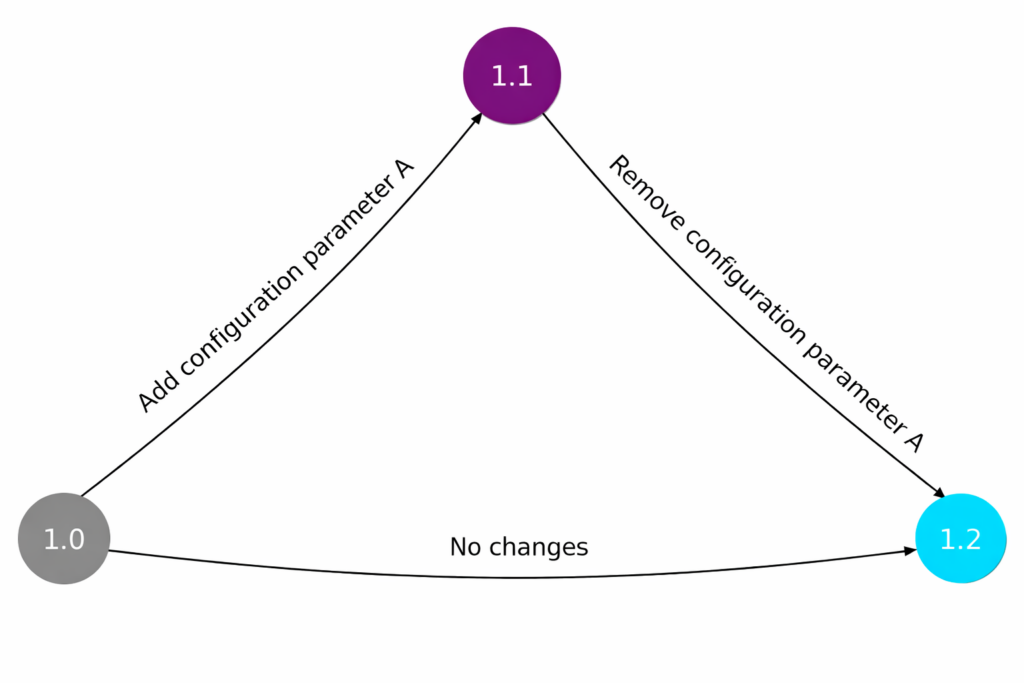
Graph-based file updates are based on a model where every software version is represented as a node within a directed graph. Directed edges (connections) exist between these nodes, symbolizing possible transitions between versions. This model makes it possible to track exactly which update path must be used between two versions to ensure that all necessary intermediate steps are considered. This prevents the execution of incompatible updates or the skipping of critical intermediate updates.
Example of Graph-Based File Updates
Imagine there are three software versions: Version 1.0, Version 1.1, and Version 1.2. If an update is performed directly from Version 1.0 to Version 1.2, only the specific changes required by Version 1.2 are installed. Version 1.1 is skipped if its changes are not relevant to Version 1.2. This logic enormously reduces the update effort and saves resources.
Advantages of Graph-Based File Updates
The benefits of graph-based file updates are multifaceted:
- Bandwidth Efficiency: This method significantly reduces the required bandwidth since full images do not need to be transmitted – only the differential data between individual versions. This is a decisive advantage for devices with limited resources or slow networks.
- Increased Speed: This targeted approach drastically increases update speeds. The update process is completed faster, thereby reducing device downtime.
- Reliability and Security: Managing graph-based file updates enhances reliability because every transition between software versions is mapped transparently. This structured approach enforces the validation of all dependencies and ensures that version jumps (especially security-relevant or incompatible ones) are only permitted if all required intermediate states are either covered by differential updates or supported by the target system. This prevents unpredictable behavior, integrity violations, or inconsistencies in the update process – a crucial factor for safety-critical devices.
ARCANIX Configuration Management: A Practical Example
One example of an OTA solution that effectively utilizes graph-based file updates is ARCANIX Configuration Management. Developed by the Austrian company ARCANIX OG, this platform enables efficient and reliable updates for IoT devices. Using a graph-based model, ARCANIX offers intelligent and scalable update management that saves time and reduces errors. Furthermore, the platform is flexible and independent of the target device’s operating system, ensuring universal applicability.
CRA Compliance & Regulatory Relevance
The requirements of the EU Cyber Resilience Act (CRA) place security, updateability, and transparency of connected products in the spotlight. OTA solutions with graph-based file updates make a significant contribution here: they not only provide traceable and versioned update paths but also offer a technical foundation that is CRA-compliant through features such as Zero-Trust architecture, certificate-based authentication, and supply chain security. Manufacturers providing IoT products in the European market benefit from this technology – not just to meet minimum regulatory requirements, but as a strategic foundation for resilience, product safety, and market acceptance.
Conclusion
Graph-based file updates form the technological basis for robust, scalable, and secure OTA update management in the IoT sector. Their ability to transmit differential changes in a targeted and dependency-aware manner allows for precise control of update processes while minimizing resource consumption. The integration of such mechanisms into platforms like ARCANIX Configuration Management demonstrates how a versioned, graph-based approach minimizes risks, enhances supply chain security, and meets compliance requirements. For companies managing IoT fleets, this approach is no longer a futuristic concept – it is a strategic building block for sustainable, automated software maintenance in productive system landscapes.
 English
  German